Sesame seeds exporters from India supply over 30-40% of global sesame trade, making India the single most practical sourcing origin for procurement managers who need scale, variety, and year-round availability. This guide covers everything you need to evaluate, shortlist, and work with the right exporter — grades, pricing, certifications, red flags, and the exact documents to demand before your first shipment.
Table of Contents
If you’re looking for sesame seeds exporters from India, you already know that finding a supplier who quotes a good price is easy. Finding one who ships the right grade, on time, with clean documentation, and zero port rejections—that’s the harder part.
This guide is written for procurement managers, import managers, and international buyers who are past the basics. You won’t find fluffy definitions of what sesame seeds are here. What you will find is the practical information that most exporter websites deliberately leave out: how pricing actually works, what certifications to verify, which documents to demand, and the specific reasons why sesame shipments get rejected at EU and US ports.
Let’s get into it.
Why Sesame Seeds Exporters from India Dominate Global Trade
India is consistently one of the world’s top two or three sesame exporters, depending on the year. Annual export volumes typically range between 600,000 and 800,000 metric tons, roughly 30–40% of global sesame trade flowing out of a single country.
The main buyers sourcing from sesame seeds exporters from India are China (which imports Indian sesame in enormous volumes for oil crushing), Japan and South Korea (quality-sensitive buyers paying premiums for clean, high-purity lots), Vietnam, and the Middle East, particularly for tahini production in Lebanon, Turkey, and Israel.
Why does India hold this position? A few reasons that actually matter to buyers:
High oil content. Indian sesame seeds consistently test at 48–52% oil content. That’s not marketing, it’s a function of the soil profile and climate in the growing regions. For buyers supplying food processors or oil mills, this directly affects yield per ton.
Year-round availability. India has two harvest seasons: the Kharif crop (harvested October–December) and the Rabi crop (February–March). This means you can source almost any time of year, unlike single-season origins like Ethiopia or Sudan.
Variety and processing infrastructure. India can supply natural/unhulled, hulled, roasted, black, and organic varieties, often from the same sesame seeds exporter. That matters if you’re sourcing for multiple applications or clients under one supply agreement.
How does India compare to other origins? Ethiopia produces sesame with a distinct nutty flavor profile that Japanese buyers particularly prize, it commands a premium for that reason. Sudan is a significant producer but has faced logistical and quality consistency challenges. Myanmar is a smaller but growing origin with competitive pricing. For most buyers seeking reliable, large-volume, multi-grade supply, working with sesame seeds exporters from India remains the most practical and cost-effective choice.
For import managers actively evaluating sesame seeds exporters, India offers something no other single origin can: scale, variety, and year-round supply under one roof.
Types of Sesame Seeds Available for Export
Not all sesame seeds are the same, and getting the wrong grade for your application is an expensive mistake. Here’s what’s actually available from Indian exporters and what each type is best suited for.
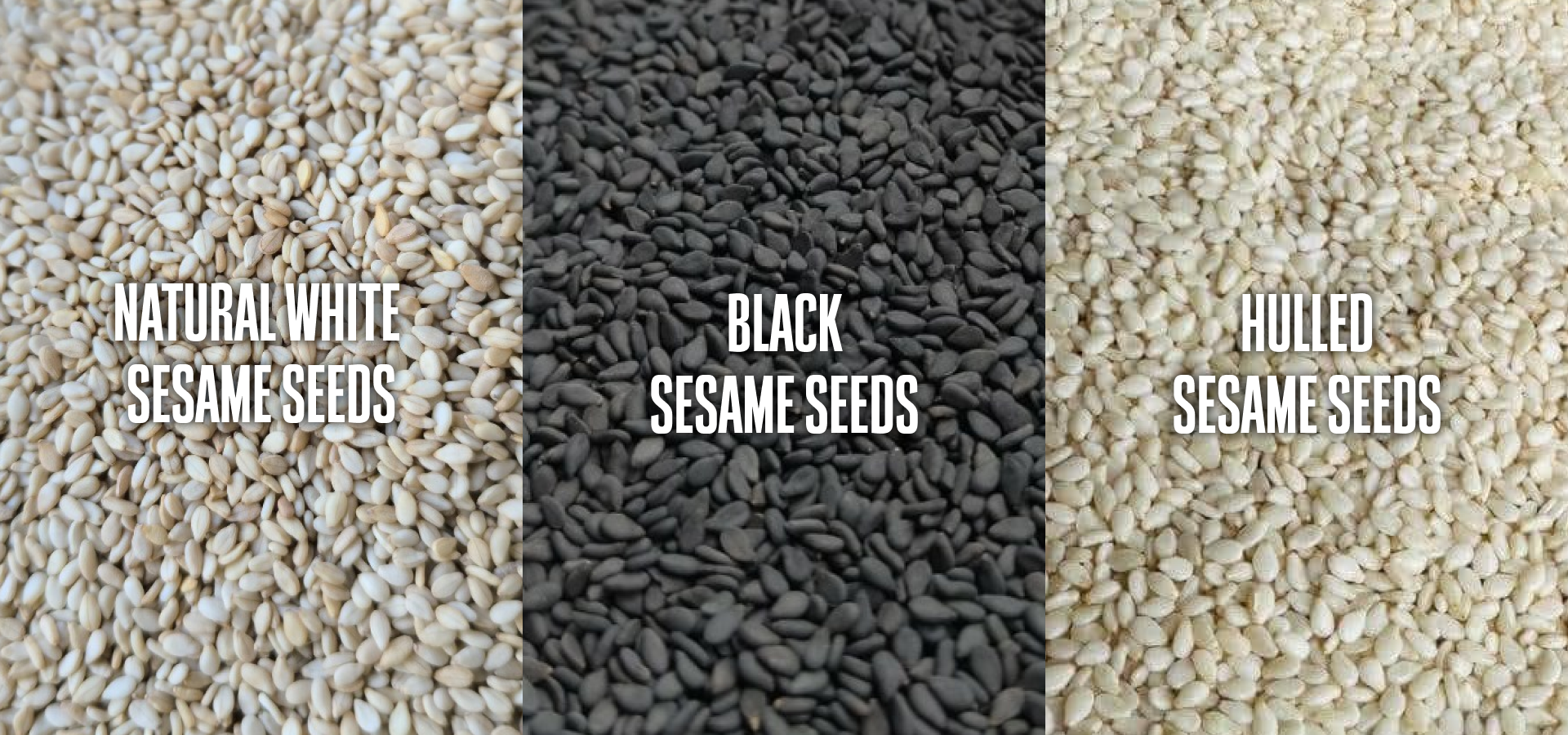
Natural sesame seeds This is the most commonly traded variety. The outer hull is intact, giving the seed its characteristic pale ivory to cream color. Natural sesame works well for baking (burger buns, breadsticks, flatbreads), tahini production, and seasoning mixes like za’atar. If your buyers are large bakeries or tahini manufacturers, this is almost certainly what they need.
Hulled sesame seeds The outer hull has been removed through a water-soaking and mechanical separation process. The result is a brighter white seed with a slightly milder flavor. Hulled sesame is preferred by snack manufacturers, confectionery producers, and anyone making premium sesame-coated products where appearance matters. It commands roughly a 15–25% price premium over natural sesame, mainly because of the processing cost and higher moisture risk post-hulling. India accounts for a significant share of global hulled sesame seeds export, with major volumes going to Japan, South Korea, and the EU food processing sector.
Black sesame seeds These are a separate variety entirely, not just dyed seeds. Black sesame has a stronger, more bitter-nutty flavor and is used widely in Asian cuisine, think Japanese gomashio, Korean black sesame rice cakes, or Chinese tang yuan filling. There’s also a growing market in health supplements because black sesame is associated with higher antioxidant content. Volumes are smaller than white sesame, and pricing can shift significantly depending on demand cycles from Japan and China.
Roasted Sesame Seeds Dry-roasted to varying degrees, these are ready-to-use for food manufacturers and foodservice distributors. The challenge with roasted sesame is shelf life, moisture reabsorption post-roasting can cause rancidity. Any serious exporter supplying roasted sesame should have controlled cooling, nitrogen flushing, or vacuum packaging as standard practice.
sesame seeds exporters India bulk supply
Grade structure matters for negotiation. Indian sesame is broadly graded by purity:
- Premium Grade: 99.97% purity, for food retail and branded consumer products
- Regular Grade: 99.95%, for food processing and industrial food use
- Industrial Grade: 99.5%, almost exclusively for oil extraction
Be specific in your purchase order. “Sesame seeds, natural, 99.95% purity, 6% max moisture” is a contract-ready spec. “Good quality sesame seeds” is how disputes start.
Quality Standards Sesame Seeds Exporters from India Must Meet
When an exporter sends you a product specification sheet, you need to be able to read it critically, not just accept it at face value. Here’s what the key parameters actually mean and what to watch for.
Moisture Content (target: ≤6–8%) This is arguably the most critical parameter for import buyers. Sesame with moisture above 8% is at serious risk of mold growth and aflatoxin development during a 25–35 day sea voyage. For EU-bound shipments specifically, moisture should ideally be at 6% or below. Always ask for moisture testing at the time of loading, not just at the factory gate, a few rainy days sitting on a port dock can shift moisture content meaningfully.
Purity (target: 99%–99.99%) Purity refers to the percentage of clean, intact sesame seeds free of foreign matter, other seeds, or debris. For premium food applications, 99.97% is the upper limit. For tahini or oil production where the seeds are crushed anyway, 99.5%–99.95% is typically acceptable and gives you room to negotiate on price.
Oil Content (target: 48–52%) This matters primarily if you’re supplying oil mills or tahini processors. Higher oil content means better yield. Gujarat-origin sesame is generally prized for higher oil content. If your buyer is running an oil mill and complaining about yield, checking the oil content specification of your last shipment is a good starting point.
Free Fatty Acid, FFA (target: ≤2%) High FFA indicates the oil is beginning to degrade, affecting flavor and shelf life. A COA showing FFA creeping toward 2.5–3% should raise a flag, especially if the sesame was harvested several months ago.
Pesticide Residue This is where destination market matters enormously. The EU has some of the strictest Maximum Residue Limits (MRLs) in the world — you can verify current limits on the EU Maximum Residue Limits database. Japan’s MRLs under the Positive List System are equally stringent. The US follows FDA guidelines. Critically, what is permissible in India under FSSAI may not be permissible in the EU. If you’re supplying European food manufacturers, your exporter must test against EU MRL standards specifically, not just Indian domestic standards. For the international baseline on sesame standards, see Codex Alimentarius.
Third-party lab verification is non-negotiable for new suppliers. Ask for test reports from SGS, Intertek, or Bureau Veritas, the three most globally recognized labs. An in-house test report from an exporter’s own facility is not adequate for a first shipment. After you’ve established a track record, you can decide how much weight to place on in-house COAs.
If you’d like our full product specification sheet with all parameters by variety and grade, download it here.
Certifications Every Sesame Seeds Exporter from India Must Hold
When evaluating sesame seeds exporters from India, certifications are easy to claim and surprisingly easy to fake. Here’s what to actually look for, and how to verify each one.
APEDA Registration The Agricultural and Processed Food Products Export Development Authority is a Government of India body. Any legitimate Indian agricultural exporter must be APEDA-registered. You can verify an exporter’s registration directly on the APEDA portal using their IEC number. If an exporter claims to be a major exporter but can’t be found on APEDA’s database, that’s a serious red flag.
You can view our APEDA registration and other current certifications on our certifications page.
FSSAI License The Food Safety and Standards Authority of India regulates food processing operations within India. A valid, current FSSAI license means the exporter’s processing facility has been assessed by Indian food safety authorities. It’s the baseline. Always check the license expiry date, some exporters display old certificates on their website and hope no one looks closely.
BRCGS (Grade A or AA) The British Retail Consortium Global Standard for Food Safety is the most widely recognized international food safety certification, particularly for buyers supplying UK and European retail chains. Grade A means the facility met requirements with minor non-conformances. Grade AA signals a higher performance level. For supplying retailers like Tesco, Carrefour, or Marks & Spencer, BRCGS is often a non-negotiable baseline requirement. Certificates are valid for 12 months, always check the issue date.
Organic Certifications If your buyer market demands organic sesame, the relevant certification depends on destination:
- NOP (National Organic Program), required for US organic labeling
- EU Organic (EC 848/2018), required for EU organic claims
- NPOP (National Programme for Organic Production), India’s own standard, with equivalency arrangements with certain countries
Make sure the certification covers the specific product you’re buying. Organic certification for one product doesn’t automatically cover everything from that exporter.
Halal & Kosher For Middle East and Southeast Asian Muslim markets, Halal certification is often a customs clearance requirement, not just a preference. A credible Halal certificate should be issued by an internationally recognized Halal body, not a local, unverified one.
USFDA Registration For US-bound shipments, the exporter’s facility must be registered with the US FDA under the Food Safety Modernization Act (FSMA). This is a legal requirement. You can verify a facility’s FDA registration using their DUNS number on the FDA’s website.
A practical shortcut: Ask any new supplier to send copies of all current certificates before further engagement. Check: Is the certificate current? Does the company name match exactly? Is the certifying body legitimate? Is the scope of certification specific enough to cover sesame seeds? This takes 30 minutes and has saved buyers from very expensive mistakes.
Export Documentation: What You’ll Receive with Every Shipment
One of the most common reasons sesame shipments sit at ports, sometimes for weeks, is documentation errors. This isn’t always fraud; often it’s an inexperienced exporter who made avoidable mistakes on paperwork. Understanding what each document is and what to verify protects you.
Commercial Invoice & Packing List The invoice should clearly state: product description (variety, grade, purity level), quantity in MT and number of bags, unit price, total value, Incoterm, and HS code. The HS code for sesame seeds is 1207.40, verify this is correct because it directly affects import duty calculation at your destination. The packing list should reconcile exactly with the invoice: bag count, net weight, gross weight per lot.
Bill of Lading (BL) This is the critical document for taking possession of your cargo. Original BL means three originals are issued and you need one to take delivery. Telex Release means the exporter instructs the shipping line to release cargo without original BL, useful for trusted relationships or smaller shipments. If you’re paying by LC, your bank will require original BLs. Confirm which type you’ll be using early in the process, changing this after the vessel departs creates problems.
Certificate of Origin (COO) Issued by the Indian Chamber of Commerce or APEDA, this confirms the goods originated in India. For buyers in countries with preferential trade arrangements with India, ASEAN members under AIFTA, for example, a COO can mean meaningfully lower import duties, sometimes the difference between 0% and 5–15%. Don’t overlook this document in your cost calculations.
Phytosanitary Certificate Issued by India’s Plant Quarantine authorities, this certifies the sesame is free from pests and diseases. Required by most countries for agricultural imports. Key point: it must be issued for the specific lot being shipped, not as a blanket certification for an exporter.
Fumigation Certificate This is where EU buyers need to pay close attention. Methyl bromide fumigation is banned in the European Union. EU-bound shipments must use heat treatment (56°C for 10 minutes minimum). If your exporter issues a methyl bromide fumigation certificate for an EU-bound shipment, the cargo will very likely be rejected at the EU port of entry. This is not a technicality, it’s a genuine risk that has affected multiple Indian sesame shipments.
Certificate of Analysis (COA) Should come from a third-party accredited lab and confirm that physical and chemical specs match the contracted specifications. Never accept a COA dated significantly before the loading date, sesame specs can change during storage, particularly moisture and FFA levels.
Sesame Seeds Pricing: What Drives the Cost & How to Get the Best Rate
Every listing of sesame seeds exporters from India claims “competitive prices.” None of them explain what actually moves the price. Here’s a practical breakdown.
Oil content and grade are the primary value drivers. A lot testing at 52% oil content is worth more than one at 48%, for oil processors, that yield difference is real money per ton. Similarly, 99.99% purity commands a premium over 99.95% because of the additional cleaning and sorting involved.
Variety premium. Hulled sesame costs more than natural due to processing cost and handling. Black sesame pricing is driven almost entirely by Asian demand cycles, when Chinese buyers enter the market aggressively, black sesame prices spike quickly. Roasted sesame carries the highest premium because of processing energy, shorter shelf life, and stricter packaging requirements.
Origin matters within India. Gujarat sesame, particularly from the Saurashtra region around Rajkot and Junagadh, is considered premium: high oil content, clean profile, strong export reputation. Rajasthan sesame tends toward a bolder seed size but can be more variable. Madhya Pradesh sesame is widely available and commonly used for industrial grade or oil extraction. If you’re buying for a premium food application, specifying Gujarat origin in your RFQ is worth doing.
Seasonal timing is your most powerful pricing lever. The Kharif harvest (October–December) brings the largest volume of fresh sesame to market. Prices are typically softer in November–January as exporters compete to move fresh stock. If you can time large orders to coincide with post-harvest, you’ll consistently get better rates. Buying in June–August, when stocks are tight before the new crop, means competing for whatever remains in warehouses, and prices reflect that scarcity.
Volume directly affects per-kg pricing. Any established bulk sesame seeds supplier will offer meaningfully better per-kg rates on a full 20-foot container (18–19 MT) versus a partial container (LCL). If your annual consumption is 50–100+ MT, consolidating orders into fewer, larger shipments rather than frequent small ones pays off in both freight savings and better unit pricing.
Payment terms move the price. LC at sight, payment when documents are presented to the bank, is the lowest-risk option for the exporter and typically results in the best pricing. Deferred payment terms pass credit risk to the exporter, and they will price that risk into the quote. New buyers without an established relationship should expect more conservative pricing on deferred terms.
Not ready to request a quote yet? Start with a sample. We send pre-shipment samples from active export lots, fully documented with COA, to serious buyers evaluating a new sesame supplier. Request a sample here.
Common Import Rejection Reasons & How Responsible Exporters Prevent Them
This is the section most sesame seeds exporters from India will never write on their own website. Import rejections are costly, port demurrage fees, return shipment or destruction costs, and regulatory scrutiny on future shipments. Understanding the common causes helps you ask the right questions before you commit to a supplier.
Ethylene Oxide (ETO) Contamination This became a significant issue for Indian spice and sesame exports to the EU from 2020 onwards. ETO is a fumigant used historically in some processing facilities. The EU’s permitted limit is 0.02 mg/kg, extremely low. Dozens of Indian sesame shipments were flagged through RASFF (the EU’s Rapid Alert System for Food and Feed){:target=”_blank”} between 2021 and 2023. A responsible exporter will have completely eliminated ETO from their process, use heat treatment instead of chemical fumigation, and test specifically for ETO residue on COAs for EU-bound lots. Ask any EU-facing exporter directly: “Do you test for ETO?” If they hesitate or don’t know what you’re referring to, that’s your answer.
Aflatoxin Levels Above Permitted Limits Aflatoxins are mycotoxins produced by mold, typically caused by improper storage: high humidity, poor ventilation, inadequate moisture control during warehousing. EU limits for aflatoxin B1 in sesame are 5 μg/kg, with total aflatoxins capped at 10 μg/kg. Exceedances are among the top reasons for Indian sesame rejections in Europe. The solution isn’t complicated: sesame must be stored in dry, temperature-controlled warehouses, properly bagged, and tested for aflatoxins before shipment. Ask what your exporter’s aflatoxin testing protocol is, and request the relevant test result in every COA.
Pesticide Residue Violations Indian agricultural practices sometimes involve pesticides permissible under Indian FSSAI standards but that exceed EU or Japanese MRLs. Chlorpyrifos, for example, had its EU MRL lowered to 0.01 mg/kg in 2020, essentially a ban. An exporter supplying EU buyers must test against current EU MRL limits specifically. “We comply with Indian standards” is not sufficient for EU-bound cargo.
Moisture Creep During Sea Transit A lot tested at 6.5% moisture at the factory can arrive at 8.5% after 30 days passing through humid tropical shipping routes. Professional exporters use inner liner bags, silica gel desiccants, and conduct moisture checks at the point of container stuffing, not just at the factory weeks earlier. Ask what moisture control measures your exporter applies during container packing.
Documentation Errors Wrong HS code, weight discrepancy between invoice and packing list, missing phytosanitary certificate, expired certifications attached, these unglamorous issues cause very real port delays. They’re also completely preventable. Ask a prospective exporter to describe their documentation verification process before shipment.
Packaging & Shipping Specifications
Standard packaging options:
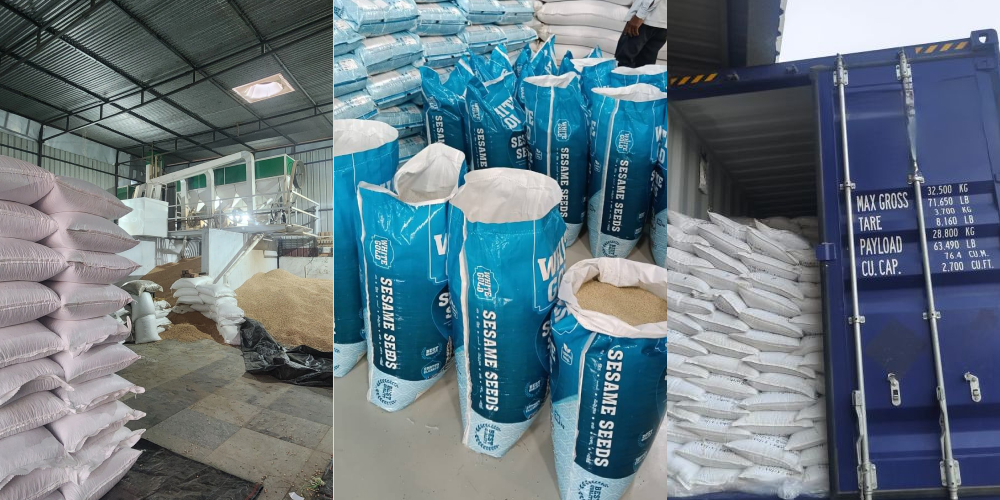
Most Indian sesame exporters use 25kg PP (polypropylene) bags as the standard unit. Jute bags (50kg) are available but less common now due to moisture risk. For hulled sesame seeds export specifically, vacuum packing in 25kg bags with an inner PE liner is non-negotiable, it preserves whiteness, prevents moisture uptake, and protects shelf life during 25 to 35 day transits.
Private label packaging is widely available. Minimum order quantities for custom-printed bags vary by exporter but are typically negotiable for buyers placing repeat orders.
Container load capacities:
- 20-foot FCL: 18–19 metric tons (standard 25kg bags)
- 40-foot FCL: 26–27 metric tons
- LCL: from approximately 1 MT upwards, though per-ton cost is significantly higher
If you’re ordering 10 MT, you’re looking at LCL, which is slower and costs more per ton than FCL. If your volume is close to a container threshold, it often makes sense to round up and save on freight.
Main ports of export from India:
- Mundra Port (Gujarat): Closest to the major sesame growing regions; preferred for Gujarat and Rajasthan origin lots; very competitive freight rates
- Kandla Port (Gujarat): Also well-positioned for Gujarat origin sesame
- Nhava Sheva / JNPT (Mumbai): India’s largest container port; excellent global connectivity but slightly more expensive for Gujarat-origin cargo due to inland haulage costs
Indicative transit times:
- Middle East (Dubai, Jeddah): 7-12 days from Mundra
- Europe (Hamburg, Rotterdam): 25-35 days
- Japan / South Korea: 20-30 days
- USA (East Coast): 30-35 days
Incoterms, what each means for your cost and risk:
FOB (Free On Board) means you take risk once goods are loaded onto the vessel; you arrange and pay freight and insurance. This gives you control over shipping line choice and is the most common term for experienced buyers. CIF (Cost, Insurance & Freight) means the exporter handles freight and insurance to your destination port, simpler, but you lose control over carrier selection. EXW (Ex Works) means you take responsibility from the exporter’s factory gate, maximum control, but maximum complexity for the buyer’s side.
How to Vet Sesame Seeds Exporters from India: 10-Point Checklist
Use this before shortlisting any new supplier.
- Verify APEDA registration. Go to apeda.gov.in and look up the exporter by name or IEC code. If they’re not listed, stop here.
- Check food safety certificate validity. Ask for the certificate PDF for any food safety certifications they hold. Check: issuing body name, certificate number, scope (does it specifically cover sesame seeds?), and expiry date. Call the certifying body to confirm if you have any doubts.
- Request two recent third-party COAs. Ask for test reports from SGS, Intertek, or Bureau Veritas on their last two export lots. In-house reports are fine as supporting documents, not as primary verification.
- Ask for destination-market specific pesticide residue testing. If importing to the EU, ask: “Do you test against EU MRL limits?” A credible exporter answers yes immediately and can show RASFF-compliant test reports.
- Request a pre-shipment sample. Any serious exporter will send a representative sample from the specific lot before you commit to bulk. Test it independently at a lab in your country.
- Confirm their fumigation method for your destination. For EU-bound cargo, the answer must be heat treatment. If they’re not aware that methyl bromide is banned for EU import, they haven’t shipped to Europe before.
- Verify IEC code and GST registration. Both are publicly verifiable, IEC through the DGFT portal, GST through the GST portal. Both should be current and active.
- Ask about shipping history to your region. How many shipments to your destination in the last 12 months? Which ports? Can they provide references from existing buyers in your market? A genuine bulk sesame seeds supplier will have a documented record of FCL shipments to your destination, not just occasional small lots.
- Evaluate their LC documentation experience. If you’re paying by LC, errors in documentation (discrepancies in weight, product description, or date) result in bank rejection and payment delays. Ask when they last successfully completed an LC transaction and with which bank.
- Consider a pre-shipment inspection (PSI) for large first orders. An inspector from SGS or Intertek physically verifies quantity, quality, and packing before the container is sealed. It costs roughly $200–$400 per container, a small fraction of what a shipment dispute costs.
If you want to run this checklist against us, we welcome it. Ask us for our APEDA number, our last two third-party COAs, our fumigation certificate process for EU cargo, and references from buyers in your region. We will answer all of it.
How to Source from Sesame Seeds Exporters from India: First Inquiry to Delivery
Most procurement managers know the theory. Here’s how it actually plays out when you work with experienced sesame seeds exporters from India.
Step 1, Submit a structured RFQ — Request a quotation Vague inquiries get vague responses. Send a specific RFQ that includes: product type and variety, purity grade, quantity in MT, destination port, required Incoterm, preferred payment terms, and certification requirements (organic, Halal, etc.). The more specific your inquiry, the more accurately the exporter can quote, and the more seriously you’ll be taken as a buyer.
Step 2, Receive and compare Proforma Invoices A PI should clearly state price per MT, quote validity period, lead time, payment terms, port of loading, and included certifications. Compare apples to apples: if one exporter quotes CIF and another quotes FOB, calculate the all-in landed cost before comparing figures.
Step 3, Request and test a sample Ask for a 250g-500g sample from the specific lot they plan to export. Send it to an independent lab in your country for testing against your relevant market standards. This takes 1–2 weeks. It’s worth it, a rejected shipment costs far more.
Step 4, Confirm order and agree on payment For a new relationship, TT advance (30-50% advance, balance before shipment) or LC at sight is standard. As the relationship matures, you can negotiate more flexible terms. Don’t let payment pressure from an exporter rush you past quality due diligence.
Step 5, Pre-shipment inspection (optional but recommended for first orders) If you’ve commissioned a PSI, the inspection happens at the exporter’s warehouse before container stuffing. You receive an inspection report confirming quantity, quality, and packing compliance before the container is sealed.
Step 6, Shipment and documentation Once goods are loaded and the vessel departs, the exporter prepares the full documentation set: BL, commercial invoice, packing list, COO, phytosanitary certificate, fumigation certificate, and COA. For LC transactions, these are presented to the bank within the stipulated period.
Step 7, Customs clearance at destination You or your customs broker use the BL and documentation set to clear customs. Any discrepancy between the documents and the physical cargo gets flagged here, which is why clean documentation at origin is so important.
Typical total lead time: 7-15 days from order confirmation to vessel loading for standard grades. Add transit time for your destination. First-time orders often run longer due to sample testing and documentation setup, plan for 4-6 weeks from first inquiry to cargo in hand, and communicate that timeline to your internal stakeholders.
Frequently Asked Questions
What is the minimum order quantity for sesame seeds export from India? Most established exporters have a minimum order of 5 MT for LCL shipments, though full container loads (18-19 MT for a 20-foot FCL) offer significantly better per-kg pricing. For first orders, some exporters may require a minimum of 5 MT. Always confirm MOQ and whether samples are available before placing bulk orders.
What certifications should sesame seeds exporters from India hold? At minimum: APEDA registration (mandatory for Indian agricultural exporters), FSSAI license, and third-party food safety certification such as BRCGS or FSSC 22000. For market-specific requirements: USFDA registration for US-bound cargo, EU Organic or NOP for organic claims, and Halal certification for Middle East and Southeast Asian markets.
What is the price of sesame seeds per kg for export? Pricing varies by variety, grade, origin within India, and market conditions. As a general reference, natural sesame seeds typically trade in the range of $1600-$1700 per MT (FOB India), while hulled sesame commands a 15-25% premium. Black sesame and organic grades carry further premiums. Contact us with your specific requirements for a current Proforma Invoice.
How long does a sesame seeds shipment from India take? Transit time depends on destination: 5-12 days to the Middle East, 18-25 days to Japan/South Korea, 20-28 days to Europe, and 25-35 days to the US East Coast. Add 7-15 days from order confirmation to vessel loading. For first-time orders with sample testing, plan for 4-6 weeks total from first inquiry to cargo in hand.
What is the difference between natural and hulled sesame seeds? Natural (unhulled) sesame retains its outer hull, giving it a cream/ivory color and slightly nuttier flavor. It is most commonly used in baking, tahini production, and seasoning blends. Hulled sesame has the hull removed, resulting in a brighter white seed with a milder flavor, preferred for snack coatings, confectionery, and premium food applications. Hulled sesame commands a higher price due to processing cost and requires more careful moisture management during export.
Ready to Source Premium Sesame Seeds from India?
Sourcing sesame seeds internationally isn’t complicated, but it rewards buyers who ask the right questions upfront. The sesame seeds exporters from India worth working with will welcome your due diligence, not resist it. They’ll have current certifications, clean documentation processes, and quality that’s consistent from lot to lot, not just on the first sample.
Get a Proforma Invoice for Your Next Sesame Shipment
Tell us your product type, grade, quantity, and destination port. We will send you a detailed Proforma Invoice within 24 hours, with current pricing, lead time, and a full specification sheet for the lot.
Not ready to commit yet? Request a product sample first. We send pre-shipment samples from active export lots, fully documented with COA, to serious buyers evaluating a new sesame supplier. No obligation, just clean sesame, properly documented, tested to your market standard.